



Reduce Missed Risk & Automate Payment Alert Decisioning
Payment screening generates alerts. Payment Screening Agent resolves them — at the speed payments demand.
Agentic AI investigates and resolves payment screening alerts in real time, reducing missed sanctions risk while transforming the economics of payment compliance — clearing false positives, improving blocking accuracy, and enabling faster payment processing through consistent, policy-aligned decisions at scale.
Reduce Missed Risk & Automate Payment Alert Decisioning
Payment screening generates alerts. Payment Screening Agent resolves them — at the speed payments demand.
Agentic AI investigates and resolves payment screening alerts in real time, reducing missed sanctions risk while transforming the economics of payment compliance — clearing false positives, improving blocking accuracy, and enabling faster payment processing through consistent, policy-aligned decisions at scale.

What is the Payment Screening Agent?
The Payment Screening Agent automatically investigates and resolves sanctions and restricted party alerts across all payment types — executing decisions, not recommendations. It analyses unstructured payment message fields, resolves entities across originators, beneficiaries, and intermediaries, and clears false positives or escalates genuine risks with fully documented reasoning aligned to institutional screening policies.
What is the Payment Screening Agent?
The Payment Screening Agent automatically investigates and resolves sanctions and restricted party alerts across all payment types — executing decisions, not recommendations. It analyses unstructured payment message fields, resolves entities across originators, beneficiaries, and intermediaries, and clears false positives or escalates genuine risks with fully documented reasoning aligned to institutional screening policies.
What is the Payment Screening Agent?
The Payment Screening Agent automatically investigates and resolves sanctions and restricted party alerts across all payment types — executing decisions, not recommendations. It analyses unstructured payment message fields, resolves entities across originators, beneficiaries, and intermediaries, and clears false positives or escalates genuine risks with fully documented reasoning aligned to institutional screening policies.

Does the Payment Screening Agent make payment screening decisions automatically?
The Payment Screening Agent automatically investigates and resolves routine payment screening alerts without manual review, delivering consistent, policy-aligned outcomes at transaction speed — with full audit trails and human oversight at the governance level. Unlike tools that generate recommendations for analysts to review, it executes decisions — enabling true straight-through processing, not assisted review.
Does the Payment Screening Agent make payment screening decisions automatically?
The Payment Screening Agent automatically investigates and resolves routine payment screening alerts without manual review, delivering consistent, policy-aligned outcomes at transaction speed — with full audit trails and human oversight at the governance level. Unlike tools that generate recommendations for analysts to review, it executes decisions — enabling true straight-through processing, not assisted review.
Does the Payment Screening Agent make payment screening decisions automatically?
The Payment Screening Agent automatically investigates and resolves routine payment screening alerts without manual review, delivering consistent, policy-aligned outcomes at transaction speed — with full audit trails and human oversight at the governance level. Unlike tools that generate recommendations for analysts to review, it executes decisions — enabling true straight-through processing, not assisted review.

How does the Payment Screening Agent help compliance teams scale alert handling?
The Payment Screening Agent applies expert-level investigation across high alert volumes, resolving up to 90% without manual intervention and achieving straight-through processing rates of up to 85%. This removes the triage bottleneck, frees compliance teams to focus on genuinely complex or high-risk cases, and enables payment screening operations to scale in line with business growth without linear headcount growth.
How does the Payment Screening Agent help compliance teams scale alert handling?
The Payment Screening Agent applies expert-level investigation across high alert volumes, resolving up to 90% without manual intervention and achieving straight-through processing rates of up to 85%. This removes the triage bottleneck, frees compliance teams to focus on genuinely complex or high-risk cases, and enables payment screening operations to scale in line with business growth without linear headcount growth.
How does the Payment Screening Agent help compliance teams scale alert handling?
The Payment Screening Agent applies expert-level investigation across high alert volumes, resolving up to 90% without manual intervention and achieving straight-through processing rates of up to 85%. This removes the triage bottleneck, frees compliance teams to focus on genuinely complex or high-risk cases, and enables payment screening operations to scale in line with business growth without linear headcount growth.

How does the Payment Screening Agent improve blocking accuracy?
The Payment Screening Agent investigates every alert in full context — entity relationships, jurisdictional exposure, counterparty risk, and multi-party payment message structure — delivering more precise blocking decisions than manual triage can achieve under time pressure, with blocking rates below industry average. Fewer unnecessary payment holds, fewer missed risks.
How does the Payment Screening Agent improve blocking accuracy?
The Payment Screening Agent investigates every alert in full context — entity relationships, jurisdictional exposure, counterparty risk, and multi-party payment message structure — delivering more precise blocking decisions than manual triage can achieve under time pressure, with blocking rates below industry average. Fewer unnecessary payment holds, fewer missed risks.
How does the Payment Screening Agent improve blocking accuracy?
The Payment Screening Agent investigates every alert in full context — entity relationships, jurisdictional exposure, counterparty risk, and multi-party payment message structure — delivering more precise blocking decisions than manual triage can achieve under time pressure, with blocking rates below industry average. Fewer unnecessary payment holds, fewer missed risks.
Deployed at Tier 1 financial institutions since 2018.
Purpose-built for sanctions and financial crime compliance — not generic AI adapted to regulated environments.
Payment Screening Challenges
Payment screening systems detect potential matches, but they do not investigate or decide.
Customer screening systems detect potential matches, but they do not investigate or decide.
Payment Screening Challenges
Payment screening systems detect potential matches, but they do not investigate or decide.
Customer screening systems detect potential matches, but they do not investigate or decide.
Payment Screening Challenges
Payment screening systems detect potential matches, but they do not investigate or decide.
Customer screening systems detect potential matches, but they do not investigate or decide.
In payments, that gap is uniquely costly:
In payments, that gap is uniquely costly:
In payments, that gap is uniquely costly:

A blocked or delayed payment creates immediate operational and customer experience consequences.
A blocked or delayed payment creates immediate operational and customer experience consequences.

As volumes grow, the problem is structural: the operating model depends on human capacity to absorb volume at transaction speed, and that dependency cannot scale.
As volumes grow, the problem is structural: the operating model depends on human capacity to absorb volume at transaction speed, and that dependency cannot scale.
The problem is structural, not just operational.
The problem is structural, not just operational.
The problem is structural, not just operational.

High alert volumes outpace team capacity, forcing shallow investigations under time pressure
High alert volumes outpace team capacity, forcing shallow investigations under time pressure

Multi-party payment messages — SWIFT MT/MX, ACH, SEPA, Fedwire — are difficult to examine and contextualise at transaction speed
Multi-party payment messages — SWIFT MT/MX, ACH, SEPA, Fedwire — are difficult to examine and contextualise at transaction speed

Inconsistent decisions across analysts increase false block risk and missed risk simultaneously
Inconsistent decisions across analysts increase false block risk and missed risk simultaneously

Poor STP rates constrain payment throughput and operational scalability
Poor STP rates constrain payment throughput and operational scalability

Payment holds create customer friction, SLA breaches, and direct revenue impact
Payment holds create customer friction, SLA breaches, and direct revenue impact

Faster payments infrastructure — CHAPS, FPS, SEPA Instant, RTP — compresses screening windows to seconds
Faster payments infrastructure — CHAPS, FPS, SEPA Instant, RTP — compresses screening windows to seconds

Manual documentation makes consistent, defensible decisions difficult to demonstrate to regulators
Manual documentation makes consistent, defensible decisions difficult to demonstrate to regulators
How the Payment Screening Agent Makes Decisions
Rather than relying solely on match thresholds, the Payment Screening Agent applies investigator-level reasoning to evaluate every alert at payment speed — combining contextual analysis with policy-aligned decision-making. The depth of investigation does not degrade as volumes grow.
Accurate screening starts with high-quality data; yet financial institutions often struggle with incomplete, missing, and duplicate records from multiple sources. Risk Data Manager (RDM) ensures clean, standardised, and reliable data, enabling stronger risk management and more accurate decision-making.
Through intelligent entity resolution and dataset consolidation, RDM enhances data integrity across internal and vendor watchlists, seamlessly integrating into your workflows. Improve efficiency, reduce errors, and drive better compliance decisions with RDM.
How the Payment Screening Agent Makes Decisions
Rather than relying solely on match thresholds, the Payment Screening Agent applies investigator-level reasoning to evaluate every alert at payment speed — combining contextual analysis with policy-aligned decision-making. The depth of investigation does not degrade as volumes grow.
Accurate screening starts with high-quality data; yet financial institutions often struggle with incomplete, missing, and duplicate records from multiple sources. Risk Data Manager (RDM) ensures clean, standardised, and reliable data, enabling stronger risk management and more accurate decision-making.
Through intelligent entity resolution and dataset consolidation, RDM enhances data integrity across internal and vendor watchlists, seamlessly integrating into your workflows. Improve efficiency, reduce errors, and drive better compliance decisions with RDM.
How the Payment Screening Agent Makes Decisions
Rather than relying solely on match thresholds, the Payment Screening Agent applies investigator-level reasoning to evaluate every alert at payment speed — combining contextual analysis with policy-aligned decision-making. The depth of investigation does not degrade as volumes grow.
Accurate screening starts with high-quality data; yet financial institutions often struggle with incomplete, missing, and duplicate records from multiple sources. Risk Data Manager (RDM) ensures clean, standardised, and reliable data, enabling stronger risk management and more accurate decision-making.
Through intelligent entity resolution and dataset consolidation, RDM enhances data integrity across internal and vendor watchlists, seamlessly integrating into your workflows. Improve efficiency, reduce errors, and drive better compliance decisions with RDM.


Alert Interception
Payment alerts generated by the institution's screening engine are intercepted before reaching investigators, enabling earlier, automated assessment in real time.
Alert Interception
Payment alerts generated by the institution's screening engine are intercepted before reaching investigators, enabling earlier, automated assessment in real time.
Alert Interception
Payment alerts generated by the institution's screening engine are intercepted before reaching investigators, enabling earlier, automated assessment in real time.


Contextual Investigation
Each alert is analysed in full context, analysing unstructured payment message fields, resolving entities across all payment parties (originator, beneficiary, intermediaries, correspondents), and assessing jurisdictional exposure and counterparty relationships to determine whether genuine sanctions or restricted party risk exists.
Contextual Investigation
Each alert is analysed in full context, analysing unstructured payment message fields, resolving entities across all payment parties (originator, beneficiary, intermediaries, correspondents), and assessing jurisdictional exposure and counterparty relationships to determine whether genuine sanctions or restricted party risk exists.
Contextual Investigation
Each alert is analysed in full context, analysing unstructured payment message fields, resolving entities across all payment parties (originator, beneficiary, intermediaries, correspondents), and assessing jurisdictional exposure and counterparty relationships to determine whether genuine sanctions or restricted party risk exists.


Policy-Aligned Decision Output
Every alert results in a clear outcome — false positive clearance, escalation, or further investigation — supported by structured reasoning that demonstrates alignment with institutional screening policies and is fully auditable.
Policy-Aligned Decision Output
Every alert results in a clear outcome — false positive clearance, escalation, or further investigation — supported by structured reasoning that demonstrates alignment with institutional screening policies and is fully auditable.
Policy-Aligned Decision Output
Every alert results in a clear outcome — false positive clearance, escalation, or further investigation — supported by structured reasoning that demonstrates alignment with institutional screening policies and is fully auditable.
Outcomes
The Payment Screening Agent improves both the accuracy and the economics of payment screening operations, reducing missed risk while transforming payment compliance throughput.
Outcomes
The Payment Screening Agent improves both the accuracy and the economics of payment screening operations, reducing missed risk while transforming payment compliance throughput.
Outcomes
The Payment Screening Agent improves both the accuracy and the economics of payment screening operations, reducing missed risk while transforming payment compliance throughput.

Up to
Alerts Resolved Without Manual Review
Up to
Alerts Resolved Without Manual Review
Up to
Alerts Resolved Without Manual Review
High volumes of payment screening alerts are investigated and resolved without manual intervention, removing the triage bottleneck and reducing reliance on investigator review.

Up to
Straight-Through Processing
Up to
Straight-Through Processing
Up to
Straight-Through Processing
Alerts are investigated and resolved by Iris 7, enabling payment decisions to be made without manual intervention and payments to move without unnecessary delay.

Improved Blocking Accuracy
Deeper, more systematic investigations reduce both false positives and false negatives — with blocking rates below industry average. Fewer unnecessary payment holds, fewer missed risks.
Improved Blocking Accuracy
Deeper, more systematic investigations reduce both false positives and false negatives — with blocking rates below industry average. Fewer unnecessary payment holds, fewer missed risks.
Improved Blocking Accuracy
Deeper, more systematic investigations reduce both false positives and false negatives — with blocking rates below industry average. Fewer unnecessary payment holds, fewer missed risks.

Faster Payment Processing
Legitimate payments are processed without unnecessary delay. Payment screening is no longer a constraint on throughput, customer experience, or business growth.
Faster Payment Processing
Legitimate payments are processed without unnecessary delay. Payment screening is no longer a constraint on throughput, customer experience, or business growth.
Faster Payment Processing
Legitimate payments are processed without unnecessary delay. Payment screening is no longer a constraint on throughput, customer experience, or business growth.

Ready for Faster Payments Infrastructure
Purpose-built to adjudicate at the speed payments demand — compatible with real-time and faster payments environments including CHAPS, FPS, SEPA Instant, and RTP.
Ready for Faster Payments Infrastructure
Purpose-built to adjudicate at the speed payments demand — compatible with real-time and faster payments environments including CHAPS, FPS, SEPA Instant, and RTP.

Continuous Improvement Over Time
Every decision feeds back into the system, improving STP rates and blocking precision over time through governed, human-approved learning cycles.
Continuous Improvement Over Time
Every decision feeds back into the system, improving STP rates and blocking precision over time through governed, human-approved learning cycles.
What This Means by Role
Customer screening alert decisioning within a governed, explainable framework.
What This Means by Role
Customer screening alert decisioning within a governed, explainable framework.
What This Means by Role
Customer screening alert decisioning within a governed, explainable framework.


Increase STP and reduce manual holds — without compromising investigation quality
Head of Payment Screening / Payments Compliance
Increase STP and reduce manual holds — without compromising investigation quality
Head of Payment Screening / Payments Compliance

Strengthen sanctions control effectiveness and improve blocking accuracy
Head of Financial Crime / Sanctions / MLRO
Strengthen sanctions control effectiveness and improve blocking accuracy
Head of Financial Crime / Sanctions / MLRO

Ensure decisions are consistent, defensible, and proportionate — at transaction speed and under regulatory scrutiny
Chief Compliance Officer
Ensure decisions are consistent, defensible, and proportionate — at transaction speed and under regulatory scrutiny
Chief Compliance Officer

Remove screening as a constraint on payment throughput and business growth
COO / CFO / Head of Payments
Remove screening as a constraint on payment throughput and business growth
COO / CFO / Head of Payments
Key Features & Governance Controls
Decision-Grade AI with Human Oversight
Payment screening alert decisioning within a governed, explainable framework — purpose-built for the speed, complexity, and regulatory stakes of payments compliance. Not generic AI adapted to regulated environments.
Key Features & Governance Controls
Decision-Grade AI with Human Oversight
Payment screening alert decisioning within a governed, explainable framework — purpose-built for the speed, complexity, and regulatory stakes of payments compliance. Not generic AI adapted to regulated environments.
Key Features & Governance Controls
Decision-Grade AI with Human Oversight
Payment screening alert decisioning within a governed, explainable framework — purpose-built for the speed, complexity, and regulatory stakes of payments compliance. Not generic AI adapted to regulated environments.


Automated Real-Time Decisioning
Payment screening alerts are investigated and resolved using structured, policy-aligned reasoning at transaction speed. Routine false positives are cleared automatically, while higher-risk matches are escalated for investigator review.
Automated Real-Time Decisioning
Payment screening alerts are investigated and resolved using structured, policy-aligned reasoning at transaction speed. Routine false positives are cleared automatically, while higher-risk matches are escalated for investigator review.
Automated Real-Time Decisioning
Payment screening alerts are investigated and resolved using structured, policy-aligned reasoning at transaction speed. Routine false positives are cleared automatically, while higher-risk matches are escalated for investigator review.


Payment Message Parsing
Unstructured payment message fields across all major formats — SWIFT MT and ISO 20022 (MX), ACH, SEPA, Fedwire — are parsed and relevant entities resolved automatically, including originators, beneficiaries, intermediaries, and correspondent banks.
Payment Message Parsing
Unstructured payment message fields across all major formats — SWIFT MT and ISO 20022 (MX), ACH, SEPA, Fedwire — are parsed and relevant entities resolved automatically, including originators, beneficiaries, intermediaries, and correspondent banks.
Payment Message Parsing
Unstructured payment message fields across all major formats — SWIFT MT and ISO 20022 (MX), ACH, SEPA, Fedwire — are parsed and relevant entities resolved automatically, including originators, beneficiaries, intermediaries, and correspondent banks.


Policy Editor and Simulator
Screening rules and decision logic can be configured to reflect institutional risk appetite. Policy changes are tested and validated in a controlled simulation environment before deployment.
Policy Editor and Simulator
Screening rules and decision logic can be configured to reflect institutional risk appetite. Policy changes are tested and validated in a controlled simulation environment before deployment.
Policy Editor and Simulator
Screening rules and decision logic can be configured to reflect institutional risk appetite. Policy changes are tested and validated in a controlled simulation environment before deployment.


Transparency and Explainability
Every decision includes structured reasoning, detailing the signals assessed and policy criteria applied — enabling full review and validation by investigators and regulators.
Transparency and Explainability
Every decision includes structured reasoning, detailing the signals assessed and policy criteria applied — enabling full review and validation by investigators and regulators.
Transparency and Explainability
Every decision includes structured reasoning, detailing the signals assessed and policy criteria applied — enabling full review and validation by investigators and regulators.


Continuous Quality Assurance
Selected alerts are sampled and reviewed by investigators to compare outcomes with agent decisions. Discrepancies are analysed to maintain alignment with institutional standards over time.
Continuous Quality Assurance
Selected alerts are sampled and reviewed by investigators to compare outcomes with agent decisions. Discrepancies are analysed to maintain alignment with institutional standards over time.
Continuous Quality Assurance
Selected alerts are sampled and reviewed by investigators to compare outcomes with agent decisions. Discrepancies are analysed to maintain alignment with institutional standards over time.


AI-Driven Continuous Improvement
Analyst feedback and decision outcomes are analysed to identify improvement opportunities, enabling ongoing optimisation of policies and investigative workflows.
AI-Driven Continuous Improvement
Analyst feedback and decision outcomes are analysed to identify improvement opportunities, enabling ongoing optimisation of policies and investigative workflows.
AI-Driven Continuous Improvement
Analyst feedback and decision outcomes are analysed to identify improvement opportunities, enabling ongoing optimisation of policies and investigative workflows.


Human-in-the-loop governance
Humans govern the policy framework that drives every decision. In production, human-over-the-loop oversight ensures the system operates within defined authority limits at all times.
Human-in-the-loop governance
Humans govern the policy framework that drives every decision. In production, human-over-the-loop oversight ensures the system operates within defined authority limits at all times.
Human-in-the-loop governance
Humans govern the policy framework that drives every decision. In production, human-over-the-loop oversight ensures the system operates within defined authority limits at all times.
Deployment
The Payment Screening Agent is available on-premises, on Silent Eight's cloud, on the institution's own cloud, or as a hybrid deployment — fitting institutional infrastructure requirements without compromise.
Institutions select the models that best suit their internal controls, operating strategy, and regulatory environment.
The deployment model only defines how Iris 7 runs and who operates it. The platform’s decisioning logic, governance, and capabilities remain consistent across all models.
Deployment
The Payment Screening Agent is available on-premises, on Silent Eight's cloud, on the institution's own cloud, or as a hybrid deployment — fitting institutional infrastructure requirements without compromise.
Institutions select the models that best suit their internal controls, operating strategy, and regulatory environment.
The deployment model only defines how Iris 7 runs and who operates it. The platform’s decisioning logic, governance, and capabilities remain consistent across all models.
Deployment
The Payment Screening Agent is available on-premises, on Silent Eight's cloud, on the institution's own cloud, or as a hybrid deployment — fitting institutional infrastructure requirements without compromise.
Institutions select the models that best suit their internal controls, operating strategy, and regulatory environment.
The deployment model only defines how Iris 7 runs and who operates it. The platform’s decisioning logic, governance, and capabilities remain consistent across all models.

The Agent operates within the Iris 7 Payment Screening Suite or can be layered onto existing screening engines.
The Agent operates within the Iris 7 Payment Screening Suite or can be layered onto existing screening engines.

It is purpose-built for financial crime compliance, not a generic AI model adapted to a regulated environment.
It is purpose-built for financial crime compliance, not a generic AI model adapted to a regulated environment.

Iris 7 has been deployed at Tier 1 financial institutions since 2018, refined through real-world operational feedback at global scale, and hardened through regulatory review, model governance, and audit cycles across multiple jurisdictions.
Iris 7 has been deployed at Tier 1 financial institutions since 2018, refined through real-world operational feedback at global scale, and hardened through regulatory review, model governance, and audit cycles across multiple jurisdictions.
Learn More About Transaction Screening Adjudicator
Harness the power of AI agents with human-in-the-loop expertise for faster, smarter case resolution and improved blocking rates. Explore more benefits and features.
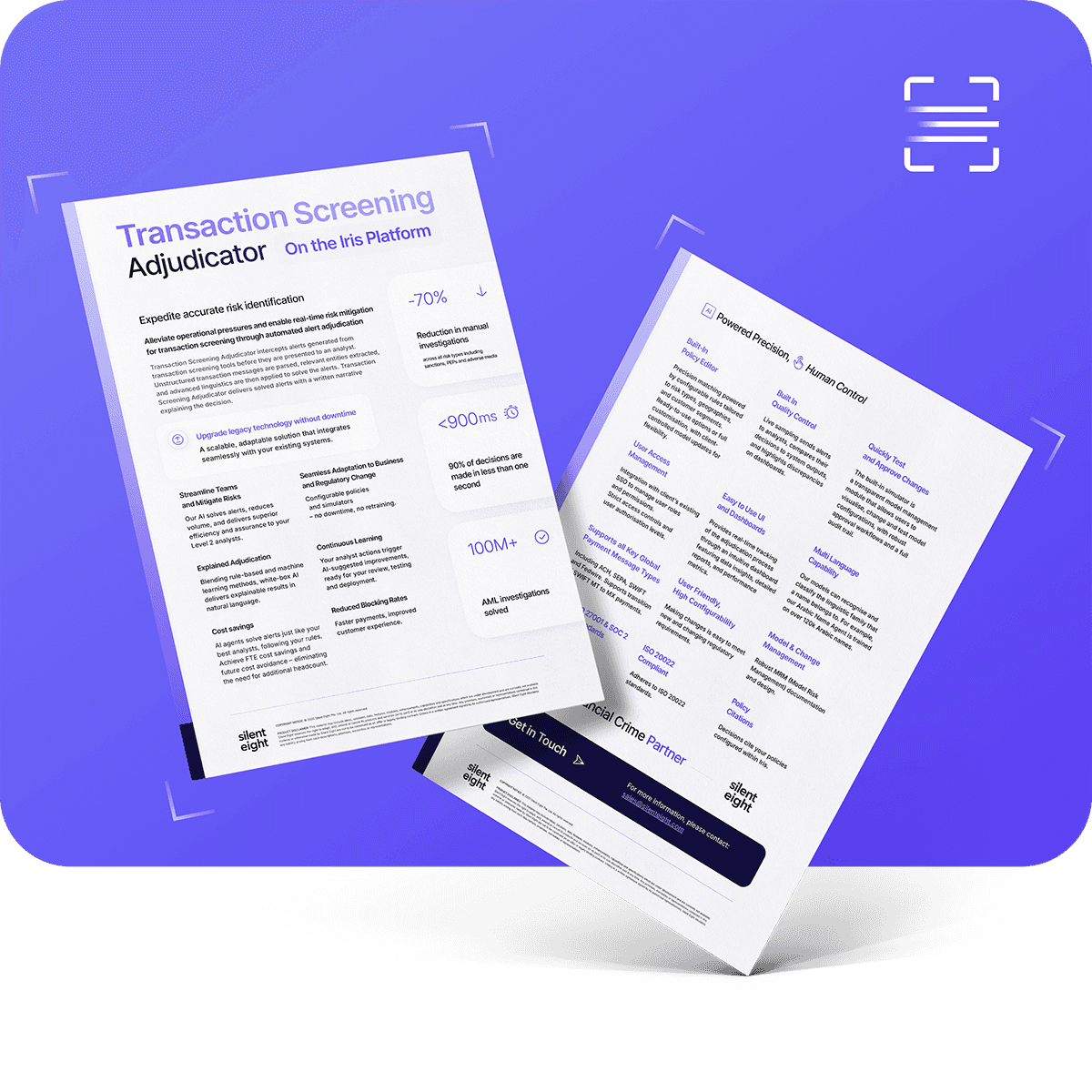
Learn More About Transaction Screening Adjudicator
Harness the power of AI agents with human-in-the-loop expertise for faster, smarter case resolution and improved blocking rates. Explore more benefits and features.
Learn More About Transaction Screening Adjudicator
Harness the power of AI agents with human-in-the-loop expertise for faster, smarter case resolution and improved blocking rates. Explore more benefits and features.
Proven in Production
Iris 7 operates in live environments within leading global financial institutions.






Proven in Production
Iris 7 operates in live environments within leading global financial institutions.
Proven in Production
Iris 7 operates in live environments within leading global financial institutions.

Interested in Iris 7?
Talk to our team about how Iris 7 can be deployed securely within your institution to deliver policy-bound financial crime decisions
Interested in Iris 7?
Talk to our team about how Iris 7 can be deployed securely within your institution to deliver policy-bound financial crime decisions