Expertise

Blog
Transaction Monitoring Under Pressure: Speed, Scale, and Scrutiny

Transaction monitoring has always been demanding. In 2026, it is under sustained pressure from multiple directions.
Payments are settling faster, customer and counterparty networks are expanding, and risk is moving through systems in tighter loops than many monitoring frameworks were designed to handle. At the same time, regulators are looking more closely at how transaction monitoring performs in practice – shifting attention from framework design to alert quality, investigative outcomes, and the consistency of decisions under time pressure.
For AML and FCC teams, transaction monitoring carries the combined weight of speed, scale, and scrutiny, turning it into one of the most operationally demanding parts of the compliance function.
Speed: when decision windows shrink, risk doesn’t wait
The growth of instant and near-real-time payment rails is fundamentally changing the conditions under which transaction monitoring operates. In many ecosystems, settlement now happens in seconds, not hours or days.
That creates a challenge AML teams know well: the faster money moves, the less time there is to decide whether it should move at all.
In practice, this often leads to uncomfortable trade-offs. When analysts can’t reach a decision within tight timeframes, institutions may be forced to cancel or delay payments by default – even when risk is minimal. The result is customer friction, operational inefficiency, and a growing gap between true risk and operational response.
As payment speed increases, regulators are not lowering the bar. Instead, they are increasingly focused on whether institutions can prioritise risk and intervene during the flow, rather than relying solely on post-event detection.
For transaction monitoring teams, speed is no longer just a payments issue – it’s a core AML design constraint.
Scale: more alerts and complexity with the same constraints
As speed challenges compliance teams to act faster, scale continues to work against teams with traditional monitoring models.
Customer bases are expanding. Product sets are broader. Transactions touch more intermediaries, jurisdictions, and counterparties than ever before. Yet many monitoring environments still rely on rule-heavy frameworks that generate high alert volumes with limited context.
This creates a familiar cycle:
Alerts spike
Investigators spend time assembling basic information
Low-risk activity consumes disproportionate effort
Genuinely complex risks compete for attention
Adding more rules or lowering thresholds rarely solves the problem. In many cases, it simply shifts noise around the system. What teams increasingly need is better signals earlier, and faster access to the context required to make confident, accurate decisions.
Without that, scale doesn’t just increase workload – it erodes effectiveness.
Scrutiny: when effectiveness is tested in outcomes, not frameworks
As transaction volumes rise and decision windows compress, supervisory attention is following the point of greatest impact: whether transaction monitoring actually produces consistent, defensible outcomes.
Across jurisdictions, regulators are spending less time debating the design of monitoring frameworks and more time examining how those frameworks perform under real operating conditions. That means closer scrutiny of alert quality, scenario calibration, investigative depth, and the rationale behind decisions – particularly where time pressure is highest.
Transaction monitoring is often where this scrutiny lands first. It is measurable, highly operational, and directly linked to SAR quality, customer impact, and regulatory confidence. Weaknesses that might have been tolerated as inefficiencies are increasingly treated as indicators of elevated risk.
For compliance teams, it is no longer enough to demonstrate coverage on paper. Teams are expected to show that monitoring decisions are risk-based, proportionate, and repeatable – even as speed and scale push operations harder than ever before.
The limits of traditional monitoring
When speed, scale, and scrutiny converge, the limits of traditional transaction monitoring become harder to ignore.
Faster payment rails compress decision windows, growing volumes stretch investigative capacity, and supervisors are asking for clearer, more consistent explanations of monitoring decisions. Together, these pressures make it increasingly difficult to rely on manual investigations, conservative defaults, or incremental rule tuning alone.
The impact shows up quickly. Alert queues grow, investigation quality becomes uneven, and low-risk activity absorbs time that should be spent on genuinely complex cases.
In some situations, institutions are forced to cancel or delay transactions simply because decisions cannot be reached within required timeframes – not because risk is high, but because their traditional system cannot move fast enough.
This is where explainable, AI-supported approaches are starting to matter. In the U.S. alone, over 72% of financial institutions are using automated transaction monitoring systems [1] – but this leaves over a quarter of firms struggling with traditional models.
By accelerating how context is assembled, how risk is assessed, and how decisions are documented, they help teams prioritize effectively, meet tight SLAs, and defend outcomes under scrutiny.
The focus shifts away from alert volume and towards the reliable delivery of timely, defensible decisions under pressure.
Exploring smarter transaction monitoring in practice
The shift toward explainable, AI-supported monitoring is no longer about experimentation. It is about understanding how these approaches can be applied in real transaction monitoring environments – to improve alert quality, accelerate investigations, and support consistent decision-making under pressure.
These are the practical questions we’ll be addressing in our upcoming online workshop, AML in Practice: Smarter Transaction Monitoring.
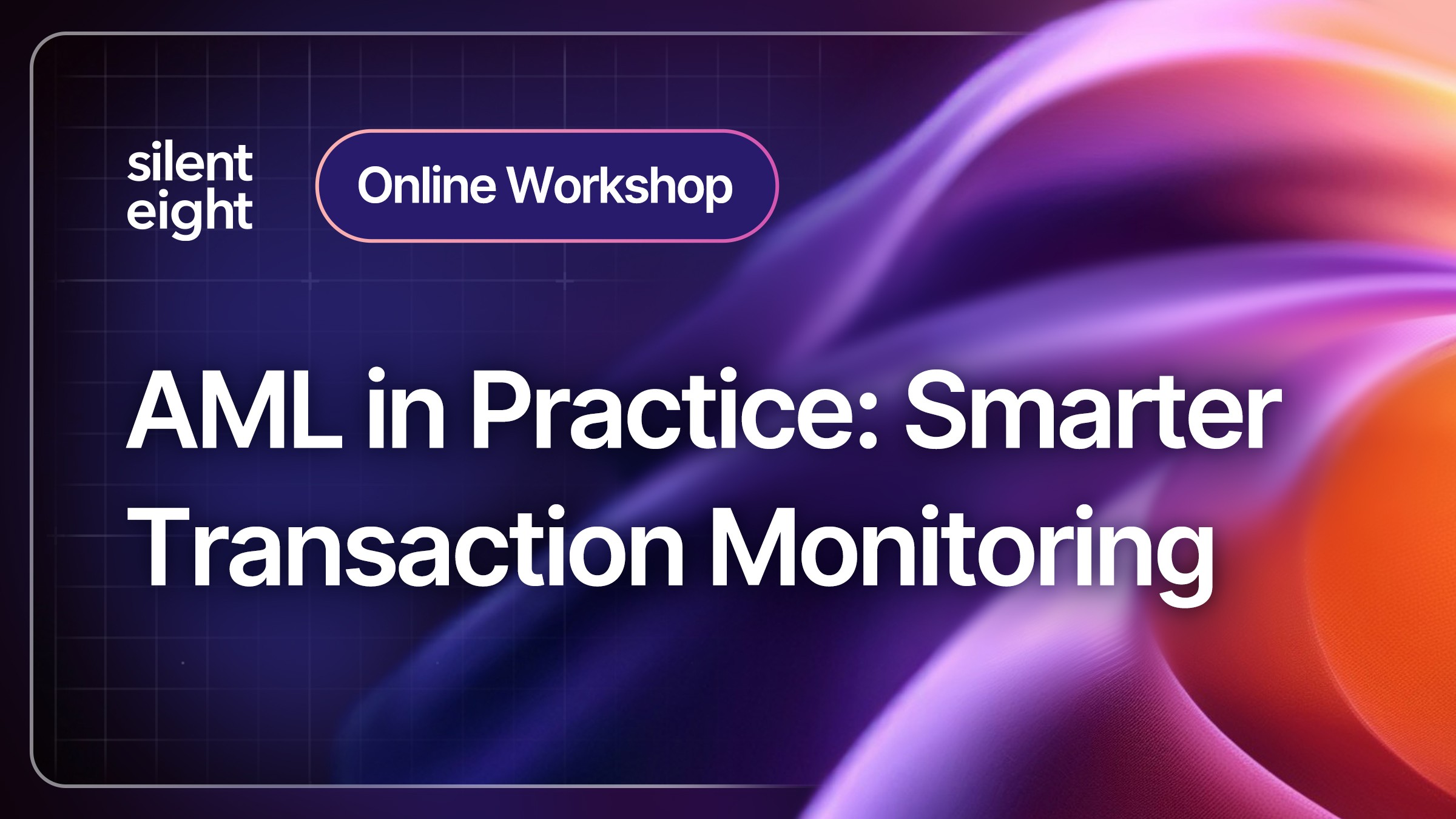
The session is designed for professionals working in transaction monitoring, AML, and wider FCC roles who want to move beyond theory and see how AI is being used to strengthen monitoring programmes without sacrificing control or explainability.
During the workshop, we’ll explore how teams are applying AI to reduce noise, surface context faster, and produce outcomes that stand up to supervisory scrutiny – with a focus on real operational challenges.
If transaction monitoring is central to your AML programme, this is a discussion you won’t want to miss. Register now to join us.
Share article